CognitiveBotics is an AI-powered therapy platform that helps children with autism spectrum disorder (ASD) acquire the cognitive, social, communication, and self-care skills they need to live independently. It augments — not replaces — in-person therapy by giving therapists a tool to design individualized learning plans, and giving parents a structured way to continue therapy at home through gamified, child-friendly activities.
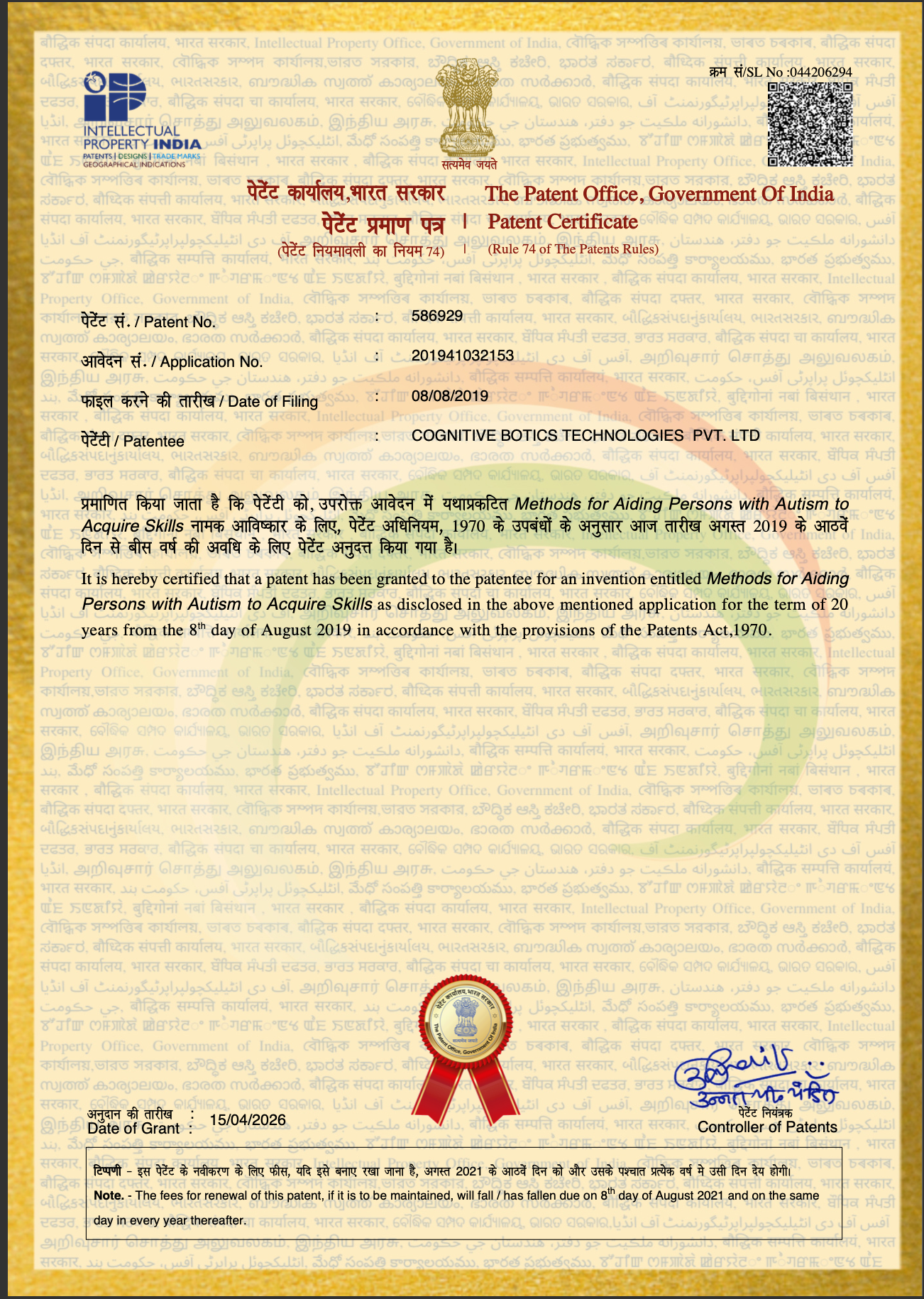
The platform is available as a mobile app on iOS and Android and as a web app on Chrome. The methods underlying the platform are protected by Indian Patent No. 586929, "Methods for Aiding Persons with Autism to Acquire Skills", granted on 15 April 2026 with a 20-year term from 8 August 2019.
Who CognitiveBotics serves
Parents get a structured, therapist-designed home program their child can play for around 20 minutes a day. The platform tracks progress automatically, removes the guesswork of "what should we work on today?", and frees up time for parents to focus on the child rather than the curriculum.
Therapists and clinicians get a way to design and assign individualized learning plans, monitor each child's progress in detail, and stay coordinated with parents through session notes and a daily journal. Multiple therapists (e.g. behaviour, speech, occupational) can collaborate on the same child's plan.
Therapy centres and admins get a single dashboard to monitor every child the centre serves, manage therapist accounts, schedule appointments, and demonstrate measurable outcomes to families and partners.
Government, CSR and Anganwadi partners get a scalable, cost-effective way to extend autism intervention to underserved communities, with central monitoring of every child's progress.
How the platform works at a glance
A therapist conducts a baseline assessment with the child, then assembles a Learning Plan made up of Learning Objectives (LOs). Each LO contains gamified content for the child plus parent-training videos that explain how to support practice at home. The child plays the assigned LOs each day for around 20 minutes — well within WHO and Indian Pediatrics Association screen-time guidance for purposeful, interactive learning. The platform records every interaction and surfaces detailed and graphical reports for both the parent and the therapist. The therapist reviews progress and updates the plan as the child masters targets.
A target is considered mastered when the child responds correctly on the first opportunity of the day for three consecutive days. A learning objective is mastered when a defined number of targets within it are mastered. This evidence-based mastery rule ensures that progression is genuine and not the result of memorisation or single-day luck.
What makes CognitiveBotics different
Two-way, active learning. Unlike passive video-based or one-way content libraries, CognitiveBotics captures every response from the child — touch, drag, speech, gaze, and pose — and reports it in real time. Parents and therapists see what worked, what didn't, and where to focus next.
Multi-modal AI detection. The platform uses pose detection (PoseNet), gaze detection, and tone/speech detection so that learning objectives can require the child to physically participate, look at the screen, or speak the answer — not just tap. This makes the learning more like real-world interaction and gives clinicians far richer signals than tap-only apps.
Parent training built in. Every learning objective includes parent-facing video content explaining the technique behind the activity, so parents become more confident co-teachers. There is also a dedicated "Watch Parent Training" video library covering occupational-therapy-based home exercises.
Multilingual. Parent-facing content is available in English (Indian and international), Hindi, and Arabic, with Telugu, Marathi, and Kannada in active development. Language preference for parent content is independent of the language used in the child's games.
Therapy-agnostic. The platform complements ABA, speech therapy, occupational therapy, behavioural therapy, and special education — therapists choose the framework; CognitiveBotics provides the digital scaffolding.
Validated. A 12-month observational study published in JMIR Neurotechnology (2025) showed statistically significant improvements across CARS, Vineland (social age and quotient), Developmental Screening Test, and REEL receptive and expressive language scores in children who used the platform consistently. The platform has also been validated by the National Institute for the Empowerment of Persons with Intellectual Disabilities (NIEPID), the Government of India's Centre of Excellence for intellectual disabilities. See The Science Behind the Platform for the full evidence summary.
A typical day on the platform
A parent opens the mobile app, sees the day's plan from one or more assigned therapists, optionally watches a short parent-training video, then sits with the child while they play the assigned LOs. The session is short — typically 20 minutes or less — and the parent stays nearby to provide encouragement and help if prompted. After the session, the parent fills in the Daily Journal with anything notable about the child's mood, sleep, or behaviour. The therapist reviews the session report and the journal entry the next time they log in, adjusts the plan if needed, and the cycle continues.
Get started
If you are a parent, your therapist will send you an SMS invite. See Parent Onboarding in this section.
If you are a therapist, your centre admin will email you an invite link. See Therapist Onboarding.
If you are an admin setting up a new centre, see Admin Onboarding and Center Setup and Deployment.
If you represent a government department, NGO, or CSR programme, see The Phygital Care Model and the For Anganwadi, Government and CSR Partners section.
You may like to read: The Science Behind the Platform · The Phygital Care Model · Product Terminologies · Frequently Asked Questions
Was this article helpful?
That’s Great!
Thank you for your feedback
Sorry! We couldn't be helpful
Thank you for your feedback
Feedback sent
We appreciate your effort and will try to fix the article